So you wanna magish. See this?…

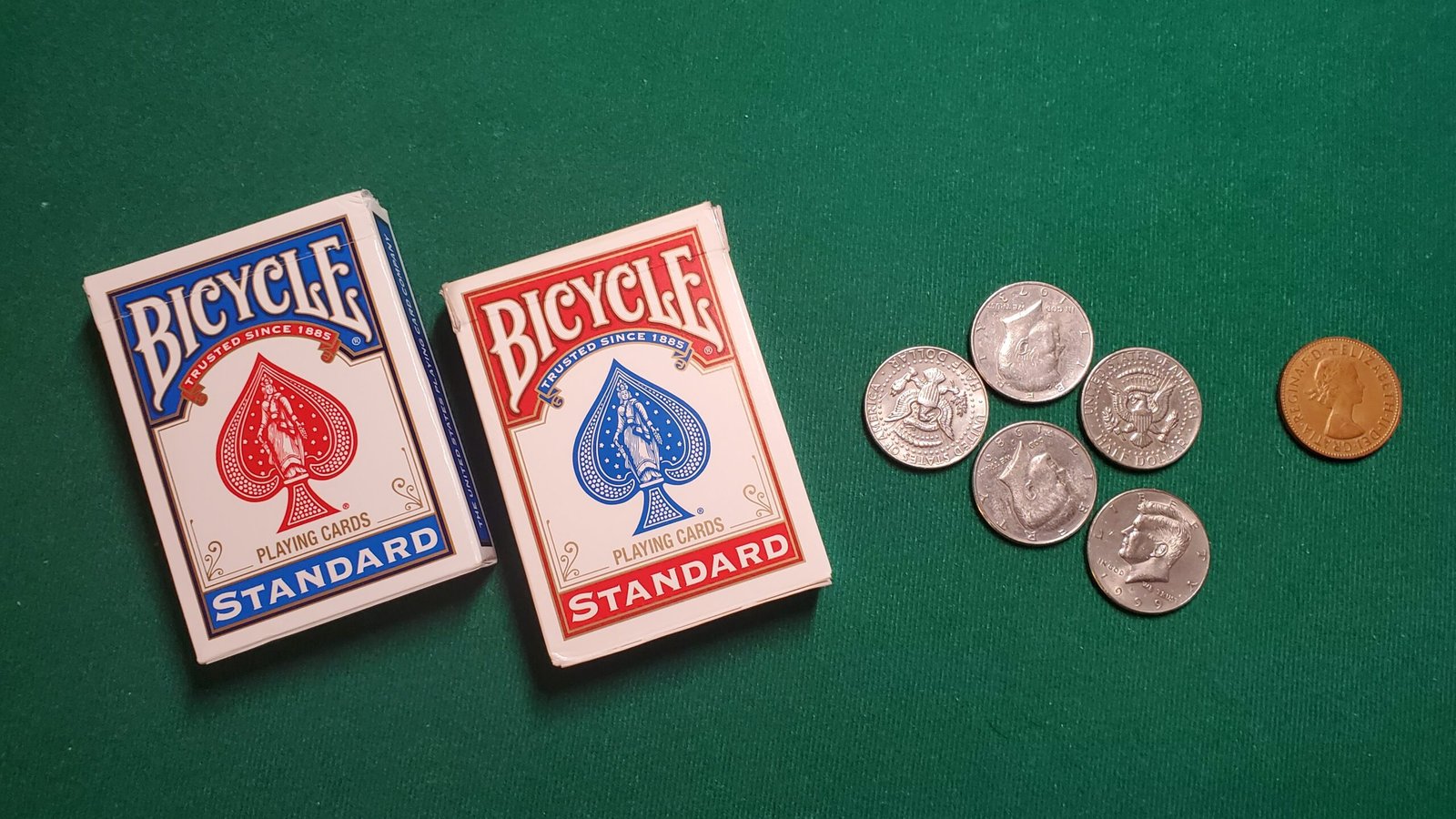
This is all you need!...
Teaching resources:
- Michael Ammar’s Easy To Master Card Miracles Vol. 1 – 6
- David Roth’s Expert Coin Magic Made Easy
Materials:
- 2 decks of Bicycle cards, one red, one blue
- 5 Kennedy half-dollars
- 1 English penny
Seriously, to start learning magic, the above is all you need! Why?
When it comes to most topics, I say there’s usually never enough information. But when it comes to starting to learn magic, I say there’s too much information out there. The internet, especially YouTube, is a disorganized hodgepodge of magic “tutorials.” The neophyte has no clue where to begin or easily becomes overwhelmed, and if they do learn something, it’s just bits and pieces – learn a thing from here, a thing from there, but never in an organized block of knowledge that truly builds a proper foundation. What I describe here is exactly how I started in magic and what I believe constitutes a concise, practical magic quick-start guide. I’ve been doing this magic thing since 1997. I’ve perused thousands of instructional resources – VHS tapes(!), DVD’s, books, downloads, etc. After all this time, I believe that the resources I started with are still the best. A lot of old-school magicians are going to consider it blasphemous that I primarily learned from video, not books, and will undoubtedly foam at the mouth that I’m not recommending any books in my quick-start guide. I mean, I also love learning from books and have acquired an extensive magic library, but video is what got me off the ground. Lets go through each resource.
Michael Ammar’s Easy To Master Card Miracles series is what I used to develop my card magic foundation. It teaches fundamental techniques within the context of actual tricks. It’s like in music – sure, you can learn chords and scales in isolation, but why not instead learn these concepts within the context of an actual song, like an etude. And since you’re learning complete tricks right out of the gate, you can get to performing as soon as the opportunity arises.
Approach the series starting with volumes 1 and 2. After you’ve digested those, get volumes 3 and 4. When you’ve digested those, get volumes 5 and 6. Volumes 7, 8, and 9 do exist. They’re ok, but volumes 1 thru 6 contain the most classic of the classics. Don’t be turned off by the fact that these are aimed towards the beginner. Contained within this series are professional caliber tricks. As a matter of fact, the very trick that David Blaine performed during this Tonight Show appearance (at the 5:01 mark) is taught right in volume 1!
For decades, Michael Ammar has been recognized within the magic community as one of the art’s preeminent teachers. You’re in good hands.
David Roth’s Expert Coin Magic Made Easy is what I used to build my coin magic foundation. The series starts at the very beginning with the most basic of coin sleights and gradually progresses (as any proper course should), and of course, teaches many routines along the way. This series will take you rapidly to an intermediate level of proficiency. David Roth (not that David Lee Roth) is considered to be arguably the best coin manipulator ever.
These are the materials you’ll need. First, cards. Bicycle is the most common brand in the U.S. Buy two of them, one red, one blue. You actually may have an old Bicycle deck in your drawer. Don’t use it. Shell out the $3.50 for a new deck. Learning with a new deck in fresh condition will make things a lot easier. Second, coins. Get at least 5 Kennedy half-dollars. Do not skimp out using quarters. Some magicians will recommend that you begin learning with silver dollars. For reasons I won’t get into right now, I disagree. Start with half-dollars. You will also need an English penny. In coin magic, English pennies traditionally have been used as a contrasting coin to the half-dollar (i.e., a silver coin vs. a copper coin). However, English pennies are getting increasingly rare, so any other contrasting coin that is about the size of a half-dollar will suffice. It doesn’t necessarily have to be copper. Even a gold dollar will do, or if you wish, a poker chip.
You undoubtedly noticed that my suggestions are heavily biased in favor of card and coin magic. This was what I was interested in from the beginning. Each magician’s path starts differently. If you’re interested in starting with different genres of magic – mentalism, rope magic, silk magic, stage illusions, etc., I will point you to Mark Wilson’s Complete Course In Magic. I eventually procured this book, but it’s not what I started with, so I’m not adding it to my recommendations. Nonetheless, it’s an outstanding book that should be studied by the budding practitioner. Again, I want to keep the resources here at a minimum as not to overwhelm. Remember, this is meant to be a quick-start guide.
Where to find what you need...
- Easy To Master Card Miracles Vol. 1: https://www.penguinmagic.com/p/19749
- …Vol. 2: https://www.penguinmagic.com/p/S34522
- …Vol. 3: https://www.penguinmagic.com/p/S34523
- …Vol. 4: https://www.penguinmagic.com/p/20666
- …Vol. 5: https://www.penguinmagic.com/p/21516
- …Vol. 6: https://www.penguinmagic.com/p/S34650
- Expert Coin Magic Made Easy: https://www.tannens.com/products/46908?_pos=1&_sid=6536df9b3&_ss=r
- Bicycle Cards: readily available at CVS, Walgreens, Walmart, Target, Amazon. etc…
- Kennedy Half-Dollars: readily available from the bank
- English Penny: https://www.magictricks.com/english-penny.html
Not necessary, but really, really, helpful...
I highly recommend that you get a magician’s close-up mat. This is kind of like a placemat that has a soft, padded surface on which you can practice and perform your magic. Barring this, you can substitute a regular placemat. You just want a soft surface to work with. Though it’s possible, hard surfaces are much more difficult to deal with. Just make it easier on yourself and get a close-up mat. Find one here.
Perform!
I would be remiss if I didn’t provide any advice about performing. So my first piece of advice is, yes, to perform! Magic is a performing art. If you decide not to, that’s fine, but I believe you are robbing yourself of most of what magic can offer if you ignore the performance aspect.
I’m not going to sugar coat this – your first performances will be ruled by anxiety. You will sweat, your heart will race, your hands will shake, you will talk a million miles a minute. But I promise, with every subsequent performance, you will gain more and more experience and confidence to handle this. Trial by fire. There’s no way around it.
So who do you perform for? When you start, keep it low stakes. Perform for loved ones or friends that will be supportive. Do not perform for the ones who you know will bust your balls, even if they are family or friends. It’s tragic when a newbie quits because of a single bad performance where spectators either heckle them, or try to “catch” them then call it out, or make fun of them for messing up, or worse, the spectator responds with, “That’s so stupid!”
What do you perform? Create a go-to set of two tricks max., either two card tricks, or two coin tricks, or one card and one coin trick, and please, please, please, practice the bejeezus out of them. When given the opportunity to perform, just perform those two (or end after one if you sense your spectators aren’t “feeling it”). Don’t do more. There’s a joke in magic: How do you get a magician to show you 100 tricks? Ask them to do 1! Don’t be that dude/dudette. As they say in show biz, leave ’em wanting more.
Finally, don’t fall into a trap that all newbies fall into. When learning from videos, there’s a tendency for the newbie to “absorb” the performing persona of who they’re watching. So, when you learn from these videos, do yourself a favor and not mimic Ammar’s or Roth’s personality. Don’t be a clone. Come up with your own presentations. Make it interesting. Act like YOU, not like Ammar or Roth (even though they are both fine gentlemen).
Yer a wizard, Harry!
So there you have it. Start with the minimal resources mentioned here and stick to it. You can branch out later, but for now don’t overwhelm yourself. I wish you well in your magic journey!
Copyright ©2026 Great Beejini LLC